Conversations at the Table – Episode 01: Bea Jimenez (2022)
During the pandemic, I joined a platform called Lunchclub.
It was an AI-powered tool designed to connect professionals for networking conversations. I assumed, naturally, that it had something to do with food.
It did not.
There was no lunch. No table. No plate. Just strangers on screens, brought together by an algorithm and the particular loneliness of lockdown.
So I did what felt most natural to me.
I turned it into a place where people could talk over a meal.
That is how I met Bea Jimenez.
Bea is from Spain and now lives in Chicago. We met at a virtual table neither of us had set, and somehow, in that strange suspended season, she began telling me about her grandmother.
About a civil war.
About poverty.
About the premature death of a husband.
About what it means to keep cooking anyway.
She shared that her grandmother used to say the best gift was health. Bea smiled as she remembered this, because she had come to understand that the best gift was her grandmother herself.
Her grandmother also used to say that everything in this life has a solution except death.
“Nowadays,” Bea said, “I know she was right.”
And then came the sentence I have not been able to forget:
“She went through a lot — a civil war, the premature death of her husband, a lot of poverty. But she was always ready to make a potato omelet.”
I have been thinking about that potato omelet ever since.
Not only the war. Not only the poverty. Not only the grief. But the fact that in the middle of so much that could not be controlled, repaired, or restored, there was still something her grandmother could make.
Eggs.
Potatoes.
Oil.
Salt.
A pan.
A meal.
A way of saying: we are still here.
This is what food does at its most mysterious and most ordinary. It keeps going when everything else breaks. It gives shape to care when words are too small. It turns survival into gesture. It says, without announcing itself, that someone has remembered how to feed the living.
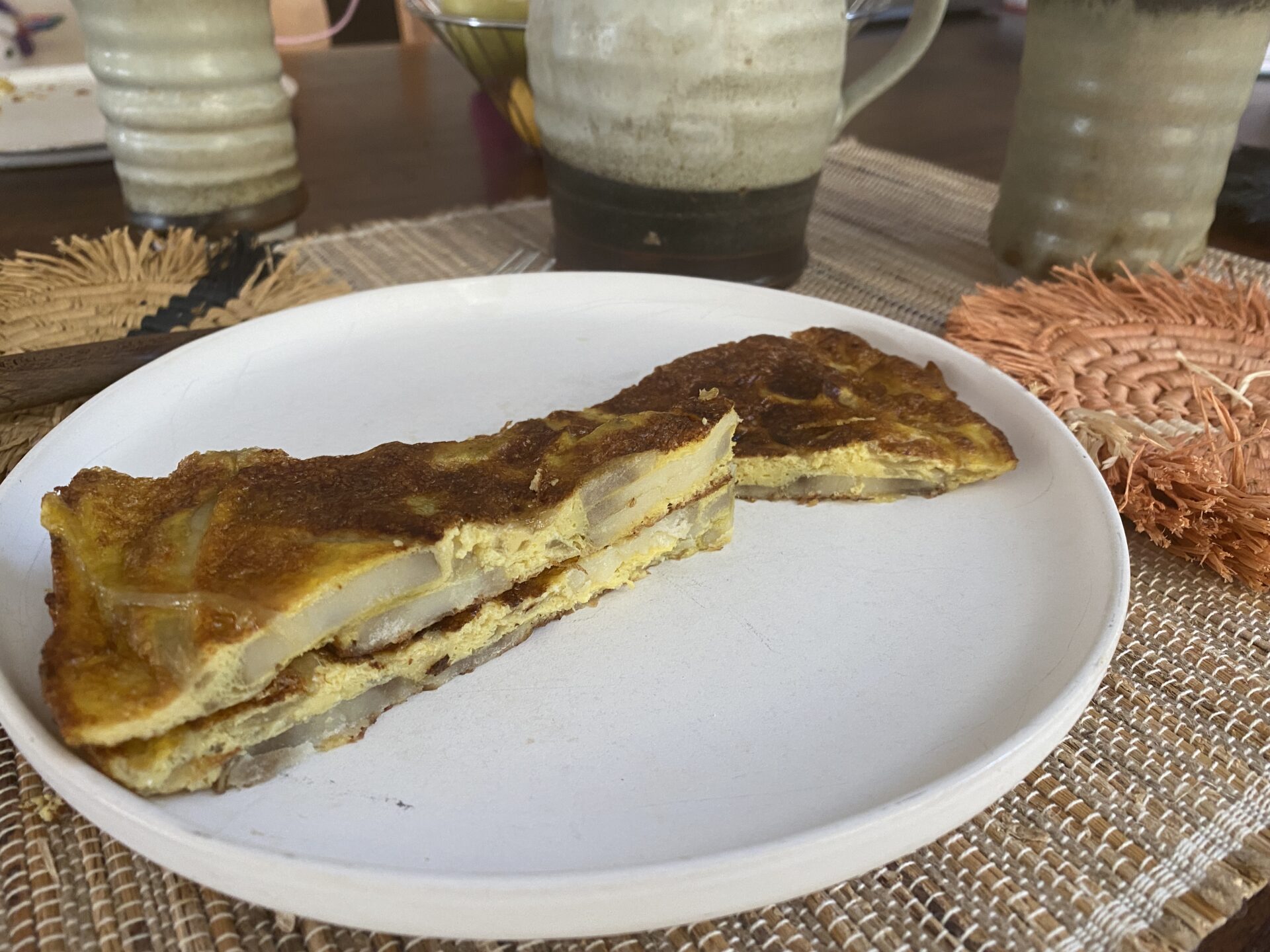
We both made tortilla de patatas during our conversation: the dish her grandmother made, the dish that carries her grandmother inside it.
A potato omelet can look simple from the outside. But simple food is often the deepest kind. It holds what a family endured. It remembers who stood at the stove when life was not gentle. It carries the hand of someone who may no longer be here, but whose way of loving has not disappeared.
This is why I wanted to begin Conversations at the Table here.
Not with a famous chef.
Not with a complicated recipe.
But with a grandmother, a granddaughter, and a potato omelet that survived everything.
Watch the full conversation below.
Once Upon a Thyme — Conversations at the Table is a series of conversations with cooks, writers, teachers, artists, and memory-keepers about the foods that shaped them.
If you have a food story, I would love to hear it.