On kefir, care, and learning to ask for what I actually need
My brother carries the world on his shoulders and makes it look like a light jacket.
He is a husband, a father of two, a professor, a football coach, and the financial spine of a family that extends in every direction. His kitchen is organized chaos: intentional, generous, always slightly overcrowded. He moves through it the way a choreographer moves through a rehearsal: plating something for one child, answering a question from across the room, refilling a glass before anyone has asked.
There is a particular kind of person who experiences serving others not as sacrifice, but as vocation.
That’s my brother.
His home is the proof.
When he asked me, the week before my visit, to send him a short list of things I would like to have in the house, I understood the gesture for what it was: an act of love offered from a very full life.
I sent three things.
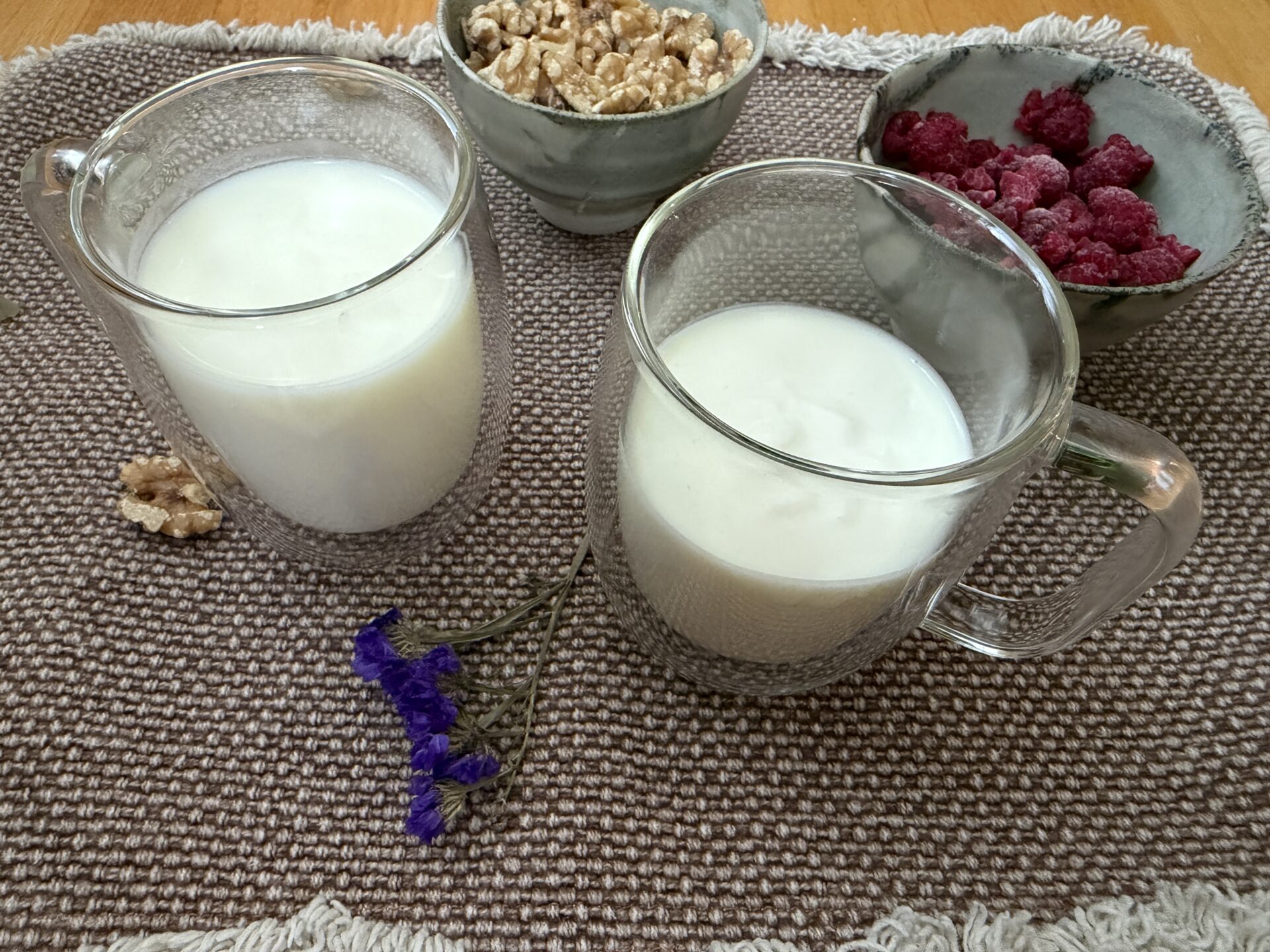
Walnuts. Frozen raspberries. Kefir.
I should have said plain kefir. Unsweetened. Unflavored. The clean, sour kind.
The morning after I arrived, I found kefir in the refrigerator. I made my smoothie, took one sip, and immediately spat it out.
It was far too sweet and flavored with vanilla.
I realized, with mild disappointment and instant guilt, that my brother must have accidentally bought the wrong kind. The sweetened kind. The kind I would never choose.
I poured a little into a glass and handed it to my daughter, who drank it without question, without fuss. She smiled and asked for more. I complied, but told her not to tell Uncle Bo.
When I saw him later, I thanked him for the kefir and said nothing more.
And I meant it, which is the complicated part.
Two days later, he called me to the refrigerator in a tone I knew immediately.
He had found, somewhere in the back, an unopened container of plain kefir.
My kefir.
Unsweetened. Unflavored. The clean, sour version.
He held it up beside the sweetened vanilla kefir, now half empty, and gave me that look.
I gave him the sheepish smile of guilt.
He had bought both. The vanilla was for himself. The plain was for me. I had found his, assumed it was mine, and never once looked further.
My kefir had been there the whole time.
Waiting.
I just had not thought to look for it.
His look softened into a smile, and we both laughed.
But something in that laughter was quieter than joy.
Because the mistake I made was so much older than kefir.
The guilt I felt was about the assumption underneath it: that what arrived first, what was easiest, what required nothing further of anyone, must be what was meant for me.
I had looked into the refrigerator, seen the first thing available, and concluded that was all there was.
I thought about a story I once heard about a married couple who, at the end of their lives, admitted they had never actually loved the things they had said they did. Every morning for years, the wife made toast with jam. She made it because she thought he loved it. He ate it because he thought she loved making it.
Neither of them liked jam.
Neither of them said so.
They were both living inside a small and tender deception, one built not from a deep reluctance to be a bother.
I recognize myself in that story more than I would like to.
I know how to name other people’s needs. I can read a room within minutes, sense what is unspoken, identify who is holding back and why. My own needs take considerably longer.
I have spent much of my life being easy to have around.
Not asking.
Not specifying.
Not looking further.
What I am learning, slowly, is that this is not generosity.
It is a kind of disappearing.
Plain, please.
No sugar.
That is what I need.
What I did not know, what I am still learning, is that saying it is not an imposition.
It is an invitation.
It lets the people who love you actually reach you.
My brother already knew what I needed. He went to the store, read the label, and put it in his refrigerator, behind everything else, where it waited for me.
Instead, I helped myself to the wrong thing and called it gratitude.
He did not need me to be easy.
He needed me to trust.