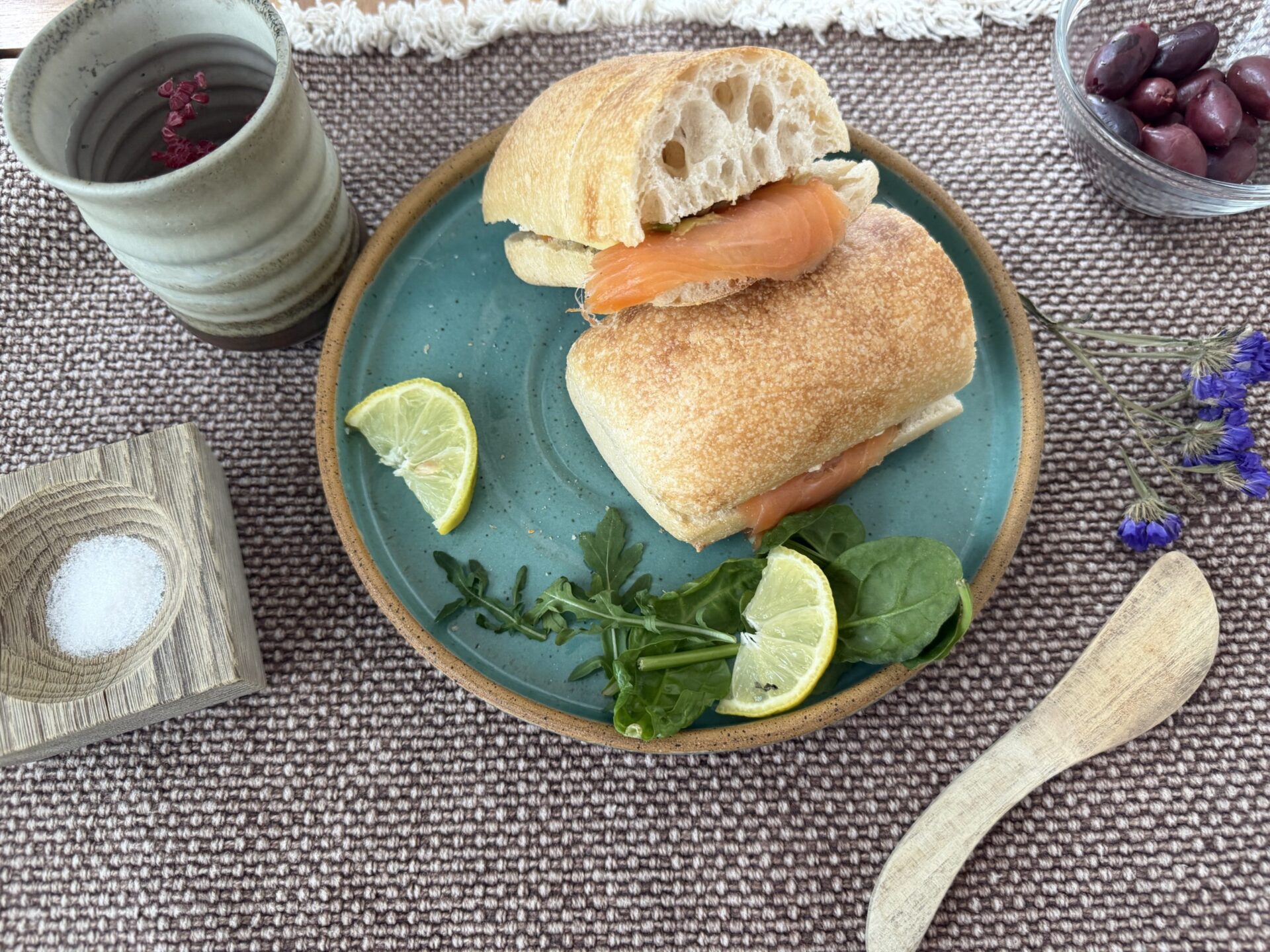
By the time I bought the sandwich, I had already forgotten to feed myself.
It was late morning, and we were somewhere between my parents’ new rented house and the beach house where we hoped a week near the sea might restore us. The taxi had pulled into a gas station. My mother, newly frail in a way I was still struggling to understand, said she was thirsty. So I jumped out and went into the little kiosk to buy her a bottle of water.
That was when I saw them: a row of sandwiches stacked in the refrigerated case, wrapped tightly in plastic. Salmon and cream cheese. Turkey and bacon. Cheese and tomato. Ordinary sandwiches. Nothing homemade, nothing beautiful, and nothing I would normally eat.
But I was starving.
I had been up since early that morning packing bags, cleaning the flat, checking medications, making sure my daughter had what she needed, making sure my parents had what they needed, making sure everyone was dressed, fed, hydrated, and ready to leave.
Everyone, apparently, except myself.
My stomach tightened when I saw the salmon sandwich. I could already imagine the first bite: cold bread, soft cream cheese, the salt of the fish, the relief of finally putting something into my body. I bought the sandwich with my mother’s water and hurried back to the car.
The driver had finished paying for gas. We pulled back onto the road. I handed my mother the bottle of water, settled into the back seat between her and my ten-year-old daughter, and unwrapped the sandwich.
Just as I lifted it toward my mouth, I saw my mother turn toward me out of the corner of my eye.
Her eyes were fixed on the sandwich.
Then she lifted one elegant index finger — the same finger that had once pointed out passages in books, taught me mathematics, corrected my table manners, stirred pots, and directed the traffic of our family life — and pointed to my sandwich.
“Could I have half?” she asked.
She said it softly. Almost shyly. She had suddenly become hungry again.
For a second, I just looked at her.
This was my mother: a mathematician, a wife, the quiet manager of our household, and the person who had spent my entire childhood making sure we were fed before she was. My mother, who could turn leftovers into lunch, lunch into dinner, dinner into occasion. My mother, who had once seemed incapable of needing anything from me.
Now she was eighty-three years old, sitting beside me in the back of a taxi, asking for half of a gas-station sandwich.
I gave it to her.
My stomach protested, but only briefly. I still had the other half. I unwrapped it, ready at last to eat, when my daughter leaned into me from the other side.
“Mummy,” she said, “can I have some too?”
She had already eaten breakfast. Or at least I thought she had. But suddenly, she too was hungry.
I could have given her a bite. I could have kept the rest for myself. I could have said, “No, darling, this is mine.” I could have done any number of reasonable things.
Instead, I handed her the second half.
And there I sat, empty-handed, between my mother and my daughter, while both of them ate my sandwich.
That was the first time I truly understood the phrase “sandwich generation.”
Not as a demographic category. Not as a sociological description. Not as a clever phrase for middle-aged adults caring for children and aging parents at the same time.
I understood it as hunger.
I understood it as sitting in the middle seat of a taxi, with my mother’s Parkinson’s-slow hands on one side and my child’s cream-cheese-covered fingers on the other, realizing that both of them needed me in different ways, and that I was the bread holding the whole thing together.
My parents had just turned eighty-three. Until recently, I would never have called them old. They were lively, brilliant, opinionated people who lived fully and argued beautifully. They were the parents I deferred to on questions of philosophy, politics, history, and life. We rarely spoke about aging. We moved through life as if it were something that would happen later, to other people, in some far-off version of time.
Then came Covid. The long confinement seemed to reveal every hidden crack — in health, in routines, in the arrangements we had all assumed would hold forever.
When my brothers and I helped move them to a new country, closer to us, closer to their children and grandchildren, we thought we were doing the loving thing. Perhaps we were. But love does not always protect people from the shock of being uprooted.
The move took more out of them than I had imagined. It took more out of all of us. The rented house was full of small disasters. The internet did not work. The appliances were complicated or broken. The stove had been installed beneath a cabinet so low that I hit my head every time I cooked. The oven knobs were worn smooth, their temperatures erased, so every loaf and dish became a guess. One morning, the toaster caught fire. One evening, we locked ourselves inside when the key jammed in the door.
Even language felt unfamiliar. It was English, yes, but every place has its own English — its own rhythms, shortcuts, assumptions, and hidden rules. We had to find doctors, pharmacies, restaurants, delivery places, repair people, familiar routes, reliable soup. The ordinary infrastructure of life had to be rebuilt from scratch.
I should have known how hard that would be. When I moved countries in my fifties, it took me months to recover. I felt disoriented, unmoored, as if my nervous system had been packed into a shipping container and had not yet arrived. So when I saw my mother weakened after the flight, sleeping longer than usual, moving with visible effort, I felt fear rise in me, then guilt.
What had we done?
And yet there we were, trying to make it work. Trying to create rest. Trying to turn a week at the beach into a remedy.
In the taxi, my mother ate slowly. Parkinson’s had made her movements more deliberate. She took small, careful bites, as if each one required attention. Or perhaps each one deserved it.
Watching her, I felt something unexpected.
Not resentment.
Not even self-pity.
Pride.
I felt proud to be her daughter. Proud that I could hand her something she wanted. Proud that, for once, care could move in the other direction. After all the meals she had made, all the sacrifices she had disguised as ordinary motherhood, all the ways she had fed us before feeding herself, here was one small chance to return the gesture.
It was only half a sandwich.
It was also everything.
On my other side, my daughter ate with the heedless pleasure of a child. Cream cheese gathered at the edges of her mouth. Crumbs fell onto the seat. She licked her fingers and looked out the window, happy, untroubled, full of the expectation that there would always be someone beside her willing to hand over the better half.
I watched her and thought: this is how love travels, not as a lesson, but as something passed, almost without thinking, from hand to hand.
My mother had given it to me.
I was giving it to my daughter.
And still, my stomach growled.
That mattered too.
Because caregiving is not only tenderness. It is also the quiet arithmetic of need: who has eaten, who has slept, who has taken their pills, who needs help standing, who needs reassurance, who needs a snack, who needs you to stay calm, who needs you not to fall apart.
And somewhere in that arithmetic, your own hunger can become easy to subtract.
For a while, I sat there feeling both things at once: the warmth of having fed them and the ache of having given away the food I needed. I told myself we would arrive soon. I would eat something later. Something more substantial. Something mine.
But the sandwich stayed with me.
Not because it was good. I barely tasted it.
Not because it was special. It was not.
It stayed with me because, for one brief ride, it showed me the shape of my life.
My mother on one side. My daughter on the other. Both fed. Me in the middle. Hungry, grateful, frightened, proud.
Held together by half a sandwich I never got to eat.