A grandmother, a daughter, and the inheritance carried by food
My daughter came home from school with a question: “Did you know Grandpa’s mother? What was she like?”
I sat with the question for a long time.
The truth is, I did not know my paternal grandmother well. She lived in Jamaica. I grew up largely elsewhere, the way diplomat’s children do: always somewhere else, always mid-arrival, always learning to belong quickly before it was time to leave again.
I can only recall visiting her a handful of times.
I cannot remember anything she might have told me. I have no memory of a piece of advice she gave me, no long conversation that stayed with me, no sentence I have carried into adulthood.
But I do remember, with absolute precision, the smell of her kitchen.
Coconut. Ginger. Brown sugar.
The particular sweetness of something being made slowly, with patience and care. The knowledge, even as a child, even before I had language for it, that I was about to be loved in the most reliable way she knew how.
Getting to my grandparents’ home from Kingston was an all-day affair. The road wound through the Jamaican countryside in long, slow curves that made me carsick every single time. I dreaded the journey, but I knew the destination was worth every nauseating mile.
We often stopped midway at a coconut vendor on the roadside.
There would be a man with a machete, a pile of green coconuts, and the practiced ease of someone who had been doing this exact thing for decades. He would crack one open in two or three clean strokes, hand it over with a straw, and I would drink the cool, faintly sweet water while the countryside shimmered around us. Then he would split the husk, and I would scrape out the soft, silky flesh with a piece of the shell itself, eating it on the side of the road as the cars drove by.
I think about that vendor sometimes when I am standing in a supermarket in Cambridge, Massachusetts, picking up a bag of dried coconut.
The distance between those two coconuts is almost too large to measure.
My grandfather always met us on the front porch. He had a particular greeting: a wet kiss on the cheek, enthusiastic and very embarrassing, which is exactly how grandparent greetings should be.
And then the smell would welcome us into the house.
Coconut. Ginger. Sugar.
The promise of something sweet.
My grandmother would come out of the kitchen to greet us, wearing an apron around her waist, sliding her palms down her hips to dry her hands.
She was always coming out of the kitchen.
Not because she had nowhere else to be, but because that was where she was most fully herself. She moved through that space by instinct, knowing by sound and smell and the way the mixture pulled away from the wooden spoon exactly when it was ready.
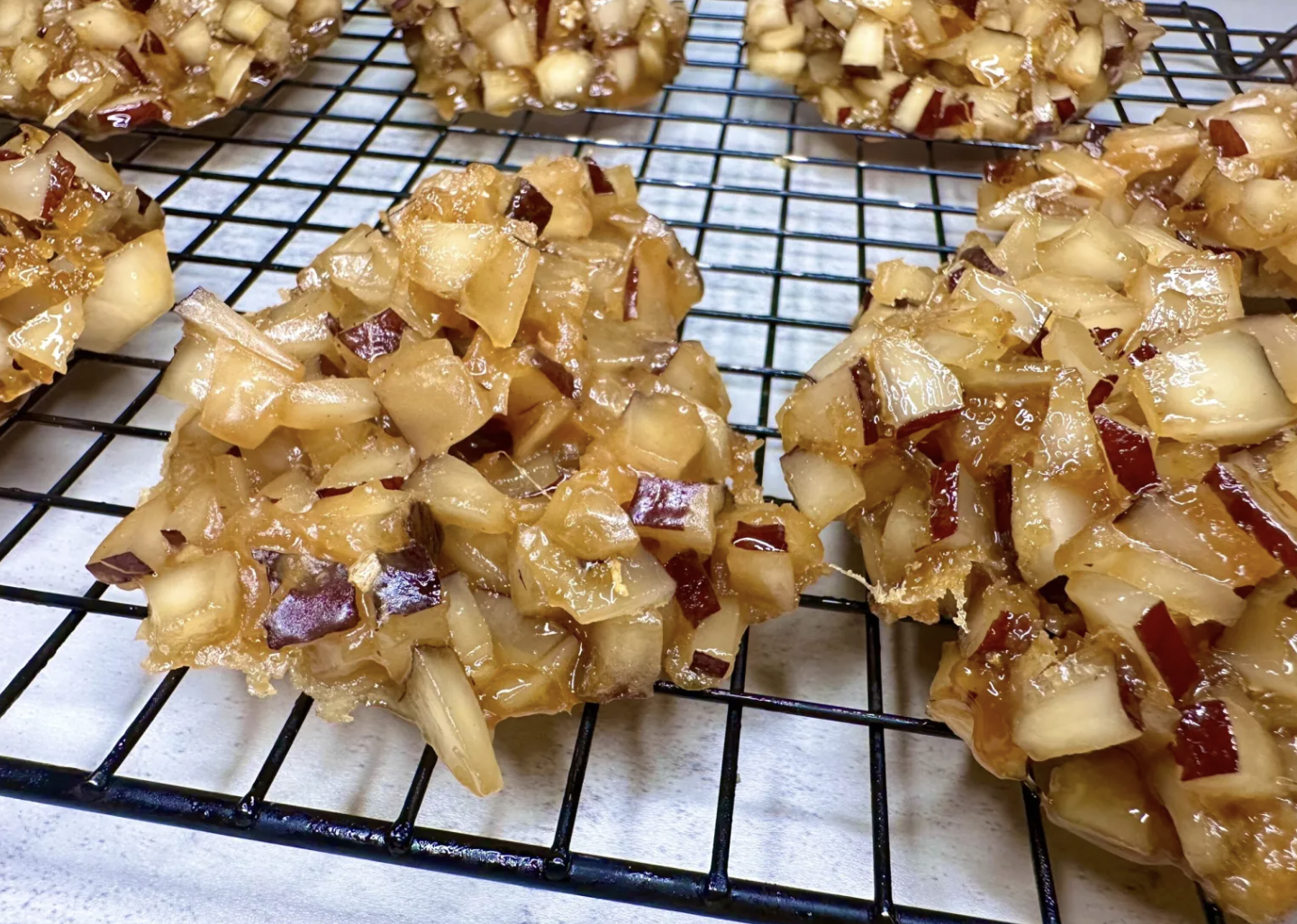
Her coconut drops were delicately delicious, and there were mounds of them on plates whenever we arrived.
Coconut drops are deceptively simple.
Fresh coconut, cut into pieces. Brown sugar. Ginger, always fresh, always generous. A little cinnamon. A little vanilla. Water enough to cover.
You bring everything to a hard boil, then turn it down and let it go: stirring, watching, waiting, until the water cooks away and the sugar becomes a thick amber syrup that coats every piece of coconut and holds them together. Then you drop spoonfuls onto a sheet and let them cool into something that is part candy, part confection, entirely Jamaican.
My grandmother made them look effortless.
They are not effortless.
They require attention and patience, a willingness to stand at the stove and tend to something until it is ready, and the wisdom to know the difference between almost there and done. The line between the two can be very thin.
I burned several batches before I understood this.
When my daughter asked me about her great-grandmother, I told her what I could.
I told her about the kitchen. The wooden spoon. The smell that met us at the door. The coconut drops cooling on a plate. The way my grandmother would watch us eat them with an expression I can only describe as satisfied. Not proud exactly. Settled. As if some important thing had been accomplished.
I told her that I could not remember a single word my grandmother said to me, but I remembered, with perfect clarity, how I felt when I walked into her kitchen.
Seen. Expected. Fed.
My daughter wrote it all down in her notebook.
Then she looked up and said, “Can we make them?”
“We can,” I said. “We can make them right now.”
And so we did.
My daughter stood on a stool beside me, watching the sugar change color, asking questions I could not always answer, learning something I could not entirely name.
Not a recipe exactly.
More like a transmission.
The thing that passes between people when words are not enough. When what you really want to say is: you are here, and I am glad, and there is something I want to give you.
My grandmother taught me without words.
I am trying to do the same.
Coconut Drops
Makes approximately 20 drops
Ingredients
1 medium dried coconut
2-3 cups water
2 cups brown sugar
1/4 cup fresh ginger, finely grated
1/2 teaspoon cinnamon
1/2 teaspoon vanilla extract
Baking sheet lined with parchment paper
Method
1. Crack open the coconut and remove the white flesh from the hard outer shell. Cut into 1/2-inch pieces and place in a large, heavy-bottomed pot.
2. Add just enough water to cover the coconut. Add the sugar, ginger, cinnamon, and vanilla.
3. Bring to a hard boil over medium-high heat, then reduce to medium. Cook, stirring frequently, for about 30 minutes, until the water evaporates and the mixture becomes a thick amber syrup that coats the coconut and becomes difficult to stir.
4. Watch carefully in the last few minutes. The difference between done and burned is a matter of moments. The mixture is ready when it holds together and pulls away from the sides of the pot.
5. Working quickly, drop spoonfuls onto the parchment-lined baking sheet.
6. Allow to cool completely before eating. They firm up as they cool.
7. Store in an airtight container. They will keep for several days, though in my experience they rarely last that long.
Note
I sometimes make a less sweet version, but it feels more like adaptation than inheritance. My grandmother would not have recognized it, and perhaps that is part of the point: recipes survive because they change, but they remember because someone keeps returning to the original.