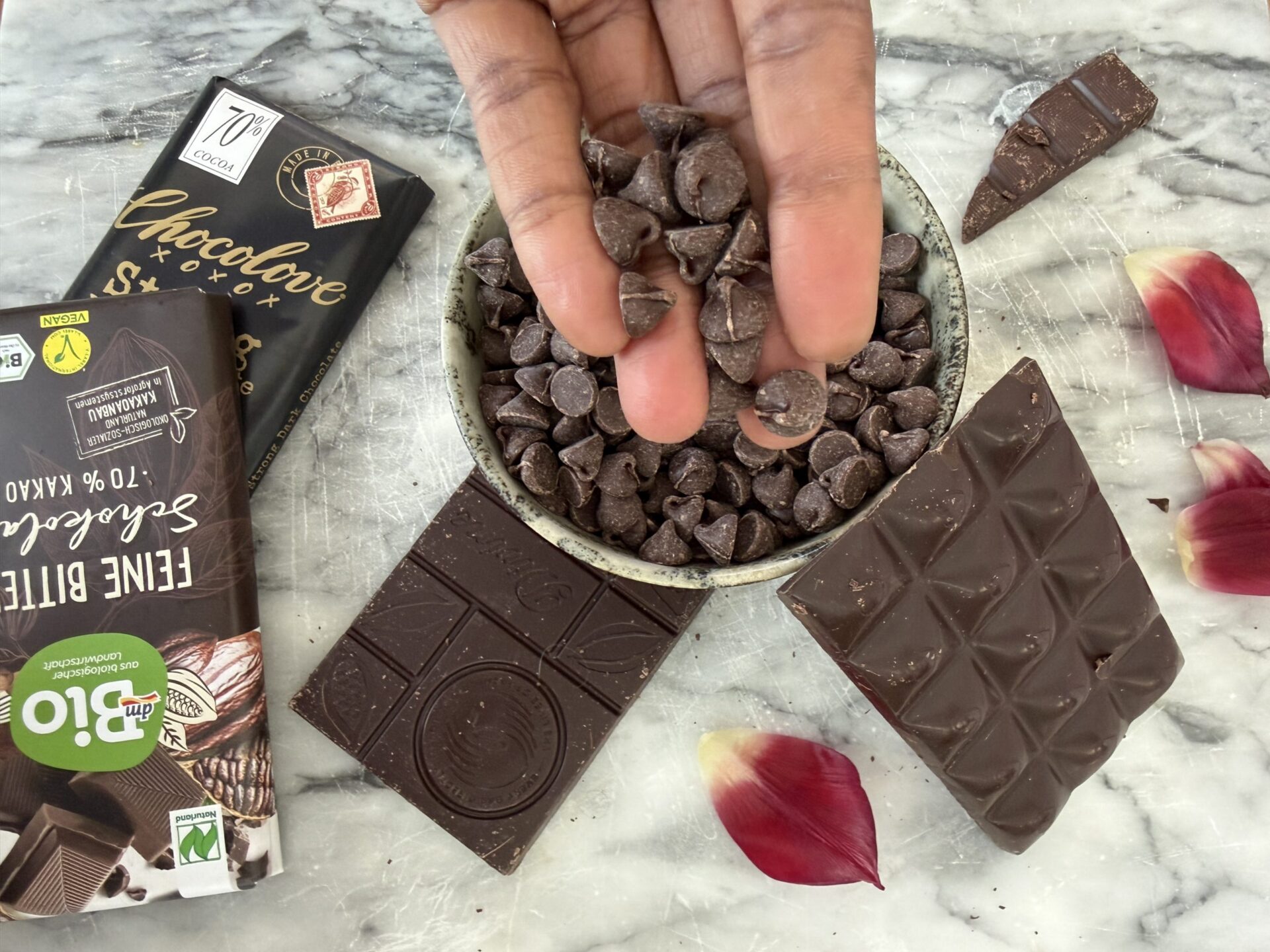
When did you last eat a piece of chocolate and think: where did this come from?
I did not, for most of my life.
Chocolate was pleasure. Comfort. A small square after dinner. A bar bought at an airport. Something wrapped, sweet, familiar, and easy to love.
And then I visited a cacao farm, and something in me cracked open — in the same way a machete cracks open a cacao pod, and I have not been able to close it since.
The pods hung from the trees like small elongated footballs: white, green, amber, deep brown. Beautiful. Strange. Almost prehistoric. I remember standing there, surrounded by cacao trees, feeling as if I had walked into the hidden life of something I thought I already knew.
Until then, chocolate had been finished.
A product.
A treat.
A thing.
On that farm, it became a story.
I learned that cacao’s history stretches back thousands of years, across ceremony, trade, conquest, appetite, and empire. I learned that cacao beans had once been as valuable as currency. I learned that as European appetite for cacao grew, so did plantation systems built through colonization and enslaved African labor.
I stood on that farm and held two truths at once: the beauty of the tree, and the weight of what it had cost.
That evening, I returned to my room and looked at the chocolate bars I had bought at the airport.
For the first time in a very long time, I did not ask whether they tasted good.
I asked: why?
Where did the cacao come from? Who harvested it? Under what conditions? Where did the sugar come from? The milk? The packaging? What did this little bar of sweetness depend on before it reached my hand?
What was the real cost — not the price on the label, but the cost hidden underneath it?
I sat with my chocolate bar and could not eat it.
Not because chocolate is evil.
But because that bar had a story to tell, and I had not been listening.
After that day, I began asking why about everything.
The meat I ate. The coffee I drank. The plastic I saw everywhere. The beautiful shoes I loved. The phones we carry. The clothes we buy. The things we throw away without thinking.
Where did this come from?
Who made it?
What did it cost?
And each time I asked, something shifted.
Not guilt, exactly. Guilt is too heavy to live inside for long. Guilt can make us turn away.
What I felt was something more useful than guilt.
Choice.
Once I knew there was a story, I could decide whether I wanted to keep participating in it. Or whether, in some small way, I wanted to help create a different one.
There is an Akan proverb from Ghana: the one who asks questions does not lose the way.
Children know this instinctively.
They ask why constantly.
Why is the sky blue? Why do people fight? Why do some people have more than others? Why do we have to go to school? Why does the world work this way?
And then, too often, school teaches them to stop.
Sit still.
Listen.
Finish the worksheet.
Give the answer.
Move on.
I know this because I was a good student. I learned the rules. I learned how to answer the questions that were asked of me. I learned how to perform knowledge.
And somewhere along the way, I stopped asking why.
It took a cacao farm to start me again.
This is what I now believe: everything has a story.
A chocolate bar has a story.
A cup of coffee has a story.
A piece of fruit has a story.
A loaf of bread has a story.
A recipe has a story.
The foods we love carry soil, labor, weather, migration, memory, trade, inheritance, and care. They carry hands we will never see and places we may never visit. They carry sweetness, yes — but also consequence.
To ask where something comes from is not to ruin pleasure.
It is to deepen it.
It is to become less innocent, perhaps, but more awake.
And I think that is what I want now — not innocence, but attention.
I want to know what I am holding.
I want to know whose labor made it possible.
I want to know what kind of world my appetite is helping to build.
I still eat chocolate.
But I do not eat it in quite the same way.
I read labels. I ask questions. I look for companies trying to do better. I think about farmers, children, soil, rain, and the long journey between a pod on a tree and a square melting on my tongue.
I do not always get it right.
None of us does.
But asking why changed something in me.
It reminded me that our daily choices are not small because they are ordinary. They are ordinary because we make them every day. And small choices, made by enough people, can become the pressure that moves systems.
So: when did you last eat a piece of chocolate and think about where it came from?
Maybe start there.
Ask why.
Not to ruin the sweetness.
To become more awake to what it holds.
Not innocence, perhaps.
Attention.
Inspired by my Tedx: youtube.com/watch?v=zOK7lw2yZaE